FREE RESOURCE FOR PROJECT MANAGERS AND PMO LEADERS
Project slipping? Make the next recovery decision clearer.
Use this free 10-question check to identify blocked work and prepare a one-page brief for your next Steering Committee.
Start with a 15-minute check. Includes fillable worksheets and a worked example.
Created by Colin De Silva · 28 years in project delivery.
The Slipping Project Check
Free recovery toolkit: a 14-page fillable PDF, a printable brief and an infographic.
Sound familiar?
Delays a status report can miss.
Milestones keep moving
The date moves with each report, even when the reasons for the delay change.
Decisions are waiting
An approval stays pending because the person responsible is busy, needs more information or doesn't know it's theirs.
Priorities conflict
The same people are needed for the project and day-to-day work, with no agreement on which comes first.
Testing becomes a queue
Work reaches testing late and all at once, before environments, data or acceptance criteria are ready.
How it works
Three steps, starting with a 15-minute check.
The 15-minute check is the starting exercise. You don't need to work through all 14 pages at once; use the worksheets and plan as the work unfolds.
- 115 minutes · start here
Check the evidence
Answer the 10 questions with Yes, Partly, No or Not sure, and note the evidence you can point to.
- 2Next · about 45 minutes
Frame the decision
Trace the blocked work, separate facts from assumptions and set out one decision on the one-page brief.
- 3Over 14 days
Agree action and review
Take the brief to your sponsor or Steering Committee, agree owners and dates, then review what actually changed.
Inside the toolkit
What you'll be working with.
Three core pages from the toolkit. Sample entries are invented to show how each page is used.
- Paperwork to Performancep. 3 to 4Illustrative example
Check the evidence.
01Can you explain the next important milestone using current evidence?
YesPartlyNoNot sure
02Does every consequential pending decision have an authorised owner and due date?
YesPartlyNoNot sure
03Are the dependencies between teams visible and confirmed by both sides?
YesPartlyNoNot sure
04Are key people available for the work the plan assumes they will perform?
YesPartlyNoNot sure
05Can you see what is started but unfinished, and why it is waiting?
YesPartlyNoNot sure
Five more questions on page 4.
Toolkit pages 3 and 4
10-question checklist
Yes, Partly, No or Not sure for each question, with the evidence behind the answer.
- Paperwork to Performancep. 8Illustrative example
The one-page brief.
- Milestone
- Billing update: start of UAT
- Most consequential blockage
- UAT scripts wait on the revised invoice rules, pending for four reports.
- Decision needed
- Approve the rules, or nominate an accountable approver.
- Owner and due date
- Project sponsor, before the next Steering Committee.
- Next review
- Confirm scripts can be finished and testers scheduled.
Toolkit page 8
One-page decision brief
The evidence, the blocked work, the decision needed, the owner and the next review on one page.
- Paperwork to Performancep. 9 to 10
A focused 14-day plan.
- Days 1 to 2Establish the position
- Days 3 to 5Make the decision
- Days 6 to 10Check implementation
- Days 11 to 14Review and decide
Illustrative example- Action 1
- Confirm the decision and the date
- Owner
- Project sponsor
- Done when
- Decision recorded and UAT readiness reviewed
Toolkit pages 9 and 10
Follow-up action plan
A 14-day rhythm with owners and dates, so you can check what moved and what is still waiting.
From blocked work to a decision someone can make.
A hypothetical project, invented to show the method. It is not a client case or a result.
1Blocked work
UAT test scripts can't be finished because the revised invoice rules are still waiting for approval.
2Decision needed
Approve the invoice rules, or nominate an accountable approver with a date.
3Owner
Project sponsor (illustrative).
4Next action
Confirm the decision and the date, then review readiness for UAT.
The toolkit gives you prompts for investigation. It is not a risk score or diagnosis, and it does not guarantee recovery.
Also included
Optional supporting materials.
Included in the toolkit for when you need them.
Six fillable worksheets
Evidence, blocked work, the decision, the brief, the action plan and the weekly review.
Worked example
A hypothetical UAT delay taken through to a decision request.
Meeting scripts
Suggested wording for asking a sponsor or Steering Committee to resolve a blocked decision.
Three AI prompts
Help organising notes and checking evidence. Don't paste confidential information into AI tools.
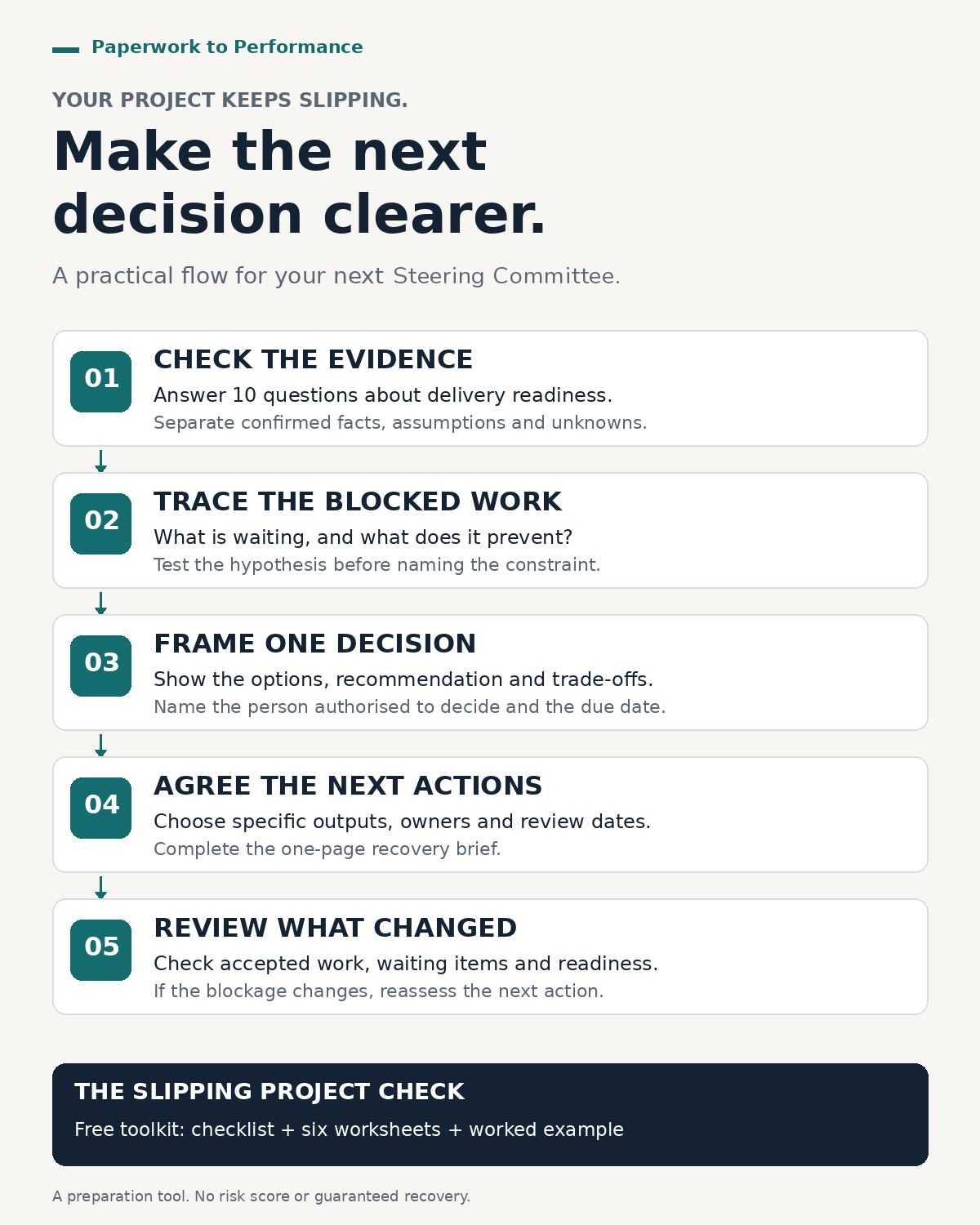
One-page infographic
A summary of the method you can keep beside the toolkit or share with your team.
Download the infographic (PNG)Who's behind it
Colin De Silva
Founder, Paperwork to Performance
28 years in project delivery
Colin's work connects technical delivery, stakeholder decisions and business outcomes. His experience includes IT relocations and office fit-outs.
He created The Slipping Project Check to help project managers take one clear, evidence-based decision to their Steering Committee.
- IT relocations
- Office fit-outs
- Stakeholder decisions
- Business outcomes
FAQs
Your questions answered.
Do I need to complete all 14 pages in 15 minutes?
No. The 15-minute check is where you start. The worksheets, brief and 14-day plan are there to use as the work unfolds, and you can come back to them at any time.
Is this a risk score or a diagnosis?
No. The questions help you identify what needs investigating. The checklist is not a validated risk score, diagnosis or prediction, and it does not guarantee recovery.
Who is it for?
Project managers responsible for a slipping IT or business change project, particularly when a Steering Committee meeting is approaching. PMO leaders and executive sponsors can also use it to prepare a clearer recovery discussion.
What do I need to give you?
Your first name and an email address. A work or personal email is fine. Please don't send confidential project information.
What happens after I sign up?
Your downloads appear on the page straight away: the 14-page toolkit, the infographic and the printable brief. We’ll also email you a copy of the links, followed by three short practical emails on days 2, 4 and 7. You can unsubscribe at any time.
Is it really free?
Yes. There is nothing to buy.
Free recovery toolkit · 14-page fillable PDF · Printable brief
Take one clear decision to your next Steering Committee.
Start with a 15-minute check. Includes fillable worksheets and a worked example.